


AlimonyDivorceProperty division
Mediation in family matters
In the Polish legal system, family mediation has in recent years become an increasingly visible alternative to traditional court proceedings, especially in divorce conflicts and disputes over parental responsibility. Mediation is a voluntary, confidential process in which a neutral and impartial third person—the mediator—helps the parties to a conflict work out an agreement on their own.
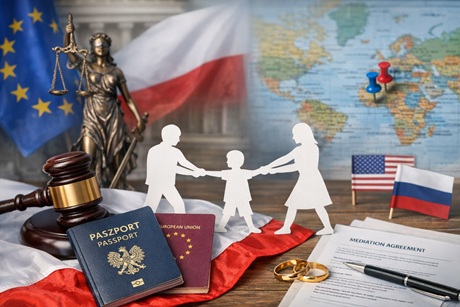
Unlike court proceedings, the mediator does not decide for the parties and does not impose outcomes; their role is to facilitate communication, help the parties understand each other’s perspectives, and support a constructive path toward settlement. The core features of mediation are voluntariness, confidentiality, and neutrality, as well as the possibility of adapting the process to the participants’ individual needs, which distinguishes it from a standard court dispute.
Family mediation covers a broad range of issues. It may concern divorce matters as well as conflicts over contact with a child, the exercise of parental responsibility, maintenance (child support), division of property, and even the rules for caring for children after the parents separate. Mediation can be conducted both before a case is filed with the court and while proceedings are pending—the court may refer the parties to mediation if there is such a possibility and if both parties agree.
The legal basis for mediation in Poland is found primarily in the Polish Code of Civil Procedure, as well as in a number of European instruments that promote mediation as an important element of the legal systems of EU Member States. The EU directive of 2008 on certain aspects of mediation in civil and commercial matters obliges Member States to promote mediation and support its use in practice, which also influences the development of mediation in family matters.
In practice, family mediation has the potential not only to resolve a dispute faster, but also to preserve the relationship between the parties at the best possible level, which is particularly important in cases involving minor children. The mediation process may—although it is not strictly required to do so—take into account the child’s best interests, helping the parties find solutions that protect the child’s welfare and reduce the trauma associated with a prolonged conflict. Mediators often draw attention to the child’s needs and encourage arrangements that are stable and workable in everyday life after the mediation ends.
In the context of family disputes involving foreign nationals, the role of mediation can be even more significant. Cross-border disputes—for example, those concerning parental responsibility where the parents or the child have their habitual residence in different countries—often create additional procedural, cultural, and language complications. Cross-border mediation can in such situations be an effective way to reach an agreement that takes account of different legal systems, cultural differences, and the parties’ specific needs. Where the parties have their habitual residence in different countries, cross-border mediation is possible, including with reference to international mechanisms such as conventions concerning child abduction or the recognition and enforcement of foreign decisions.
The case law and practice of Polish courts also point to the growing importance of mediation. Family courts increasingly recommend mediation or refer parties to it, with a view to resolving the dispute faster and reducing the burden on the courts. In practice, courts often stay proceedings to allow mediation, which can lead to an amicable settlement of issues that are crucial for the parties and their families. Judicial decisions also increasingly emphasize that taking part in mediation may demonstrate a mature approach to conflict resolution and care for the child’s best interests—factors that can be relevant to the court’s overall assessment of the case. Although mediation remains voluntary and its effectiveness depends on the parties’ willingness, experience shows that in many cases it is a real and effective alternative to lengthy court litigation.
In disputes involving foreign nationals, mediation has particular advantages. First, it gives the parties greater control over the course of discussions and the final outcome, which is especially important where cultural, linguistic, or legal differences make standard court procedures feel unfamiliar or unequal to one party. Second, mediation—conducted by practitioners with strong intercultural competence—can help the parties understand different norms and expectations, increasing acceptance of the solutions developed. Third, mediation can help avoid situations in which one parent feels excluded or misunderstood, which in the long run could intensify the conflict and negatively affect family relationships.
An important aspect of mediation is its role in creating settlement agreements that can later be approved by the court and obtain legal effect. Once approved, such an agreement becomes a basis for enforcing specific obligations—for example, those concerning contact with a child, maintenance, or rules for exercising parental responsibility. Mediation therefore not only facilitates agreement, but can also become the foundation for stable and enforceable legal arrangements.
It is also worth noting that family mediation is receiving increasing attention among legal professionals and the public, including in resources such as MEDIANA.SOS.PL, which present analyses of the mediation process, its benefits and challenges, and practical guidance for parties and professionals. The style promoted in such spaces highlights empathy, constructive communication, and attention to the real needs of participants in family conflict, which aligns with the core idea of mediation as a tool for resolving family disputes.
In summary, family mediation in Poland is an institution of growing practical and social importance. It offers a valuable alternative to traditional court disputes, especially where the parties wish to retain control over the process and minimize the negative consequences of conflict. In cases involving foreign nationals, mediation provides additional space to take into account diverse legal and cultural contexts, contributing to solutions that are acceptable to all participants. In an era of increasing mobility and the complexity of cross-border family relationships, mediation appears to be a tool well suited to contemporary challenges and—when supported by proper legal and substantive guidance—has the potential to reduce court burdens and improve the quality of life of families affected by conflict.
Articles in this category


Comments to the post