


The remaining
No Birth Certificate and Marriage in Poland: Can a Foreigner Get Married Without This Document?
The absence of a birth certificate does not necessarily rule out the possibility of getting married in Poland. Find out when a foreign national can marry without this document and how to obtain a court exemption from the requirement to provide it.
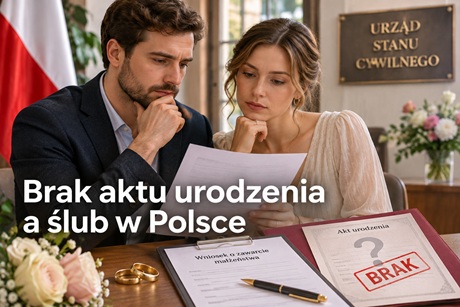
Not having a birth certificate does not necessarily mean that getting married in Poland is impossible. Although obtaining a certified copy of a birth certificate is a simple formality for most people, for some foreign nationals it can become an almost insurmountable obstacle. This problem particularly affects individuals born in countries where birth registration was not widespread, civil records have been destroyed, or access to public authorities is difficult.
There are situations in which an adult possesses a valid passport, citizenship of a particular country, identity documents, and a long history of lawful residence abroad, yet is still unable to produce a birth certificate. Sometimes the document was never issued because the birth was never registered. In other cases, the record exists, but obtaining it requires travelling personally to a country that the individual cannot return to.
Can a Polish Civil Registry Office refuse to conduct a marriage ceremony in such circumstances? Can a passport replace a birth certificate? Is it possible to obtain a court exemption from the obligation to submit this document?
The answers should primarily be sought in the Polish Civil Status Records Act, the Family and Guardianship Code, and the Code of Civil Procedure.
Not Having a Birth Certificate Can Mean Different Things
The starting point should be establishing why the foreign national does not possess a birth certificate. In practice, several distinct legal situations may arise, each requiring a different approach.
The first concerns individuals whose births were properly registered but whose certificates have been lost, destroyed, or never collected. In such cases, the problem usually involves obtaining an official certified copy of an existing record.
The second situation arises where a birth was never reported to the competent authority. This problem can be encountered in certain African and Asian countries, particularly among people born several decades ago in rural areas.
The third category concerns individuals originating from countries affected by armed conflict, natural disasters, or serious administrative crises. Civil registers may have been destroyed, lost, or become practically inaccessible.
There are also circumstances in which a document is available, but the person concerned cannot travel personally to the relevant authority. This may result from restrictions connected with their immigration status, the inability to obtain travel documents, medical conditions, or other exceptional circumstances.
Distinguishing between these situations is extremely important. Being unable to obtain a certified copy of an existing birth record is not the same as never having had one’s birth registered.
In the first situation, appointing an authorised representative abroad may provide a solution. In the second, it may be necessary to complete a late birth registration procedure or consider appropriate proceedings before a Polish court.
Is a Birth Certificate Mandatory When Getting Married in Poland?
The key provision is Article 79(1)(2) of the Polish Civil Status Records Act of 28 November 2014 (Prawo o aktach stanu cywilnego).
This provision requires a foreign national to submit a certified copy of their birth certificate if the information necessary to prepare the marriage record cannot be established from the other documents submitted.
This qualification is particularly important.
Polish law does not impose an unconditional obligation on every foreign national intending to marry to submit a birth certificate.
The requirement depends on whether the necessary information can be established using other documents.
This means that the head of the Civil Registry Office should assess the documentation presented by the prospective spouses before determining whether a birth certificate is necessary.
However, Article 88 of the Civil Status Records Act must also be taken into account, as it specifies the information that must be included in a Polish marriage record.
Such information includes the spouses’ given names and surnames, surnames at birth, marital status, dates and places of birth, and the given names, surnames, and surnames at birth of their parents.
If these details cannot be reliably established from the other documents, the Civil Registry Office may legitimately request additional evidence.
In practice, each case therefore requires an individual assessment rather than the mechanical application of the same document checklist to every foreign national.
Can a Passport Replace a Birth Certificate?
One of the most frequently asked questions is whether possessing a valid passport is sufficient to get married.
A passport is an official document confirming identity and citizenship. It usually contains the holder’s given names, surname, date and place of birth, nationality, and other identifying information.
However, it does not always contain the parents’ surnames at birth or all the details required to prepare a Polish marriage record.
For example, a person born in Ghana may possess a British passport and a British Certificate of No Impediment to Marriage. These documents may establish their identity and legal capacity to marry, but they do not necessarily contain all the information required by the Polish Civil Registry Office.
In such circumstances, it is necessary to determine whether the missing information can be established through other reliable official documents.
It would be incorrect either to assume automatically that a passport is sufficient or to dismiss its evidential value when establishing a person’s details.
The consistency of the documentation is also important. Different spellings of surnames, variations in the transliteration of given names, or discrepancies concerning dates of birth may justify further clarification.
Birth Certificate and Certificate of Legal Capacity to Marry: Two Different Requirements
In practice, birth certificates are often confused with documents confirming a person’s legal capacity to enter into marriage.
However, these are two separate documents serving different purposes.
A birth certificate primarily establishes personal details, birth information, and parentage.
A document confirming the legal capacity to marry establishes that, under the applicable law, there are no legal impediments preventing the individual from entering into marriage.
The obligation to present the latter document follows from Article 79(1)(3) of the Civil Status Records Act, except where, under the rules of private international law, the foreign national’s capacity to marry is governed by Polish law.
If obtaining a certificate of legal capacity to marry encounters obstacles that are difficult to overcome, Article 79(2) provides for the possibility of obtaining an exemption from the court.
However, such an exemption does not automatically release the person from the obligation to provide a birth certificate.
We discussed the procedure for obtaining an exemption from the certificate of legal capacity to marry in greater detail in our article “Exemption from the Obligation to Submit a Document Required for Marriage” (available in Polish).
Can a Polish Court Exempt a Foreigner from Submitting a Birth Certificate?
Yes. A particularly important legal basis is Article 3 § 2 of the Polish Family and Guardianship Code (Kodeks rodzinny i opiekuńczy).
This provision allows a court to exempt a person intending to marry from the obligation to submit a required document if obtaining it encounters obstacles that are difficult to overcome.
The provision is general in nature and may also apply to birth certificates.
It is therefore incorrect to claim that the absence of a birth certificate always makes it impossible to conduct a marriage ceremony in Poland.
Nevertheless, an exemption is not granted automatically.
The court must determine whether the difficulties described are genuine and sufficiently serious.
It is not enough simply to argue that obtaining the document is complicated, expensive, or time-consuming.
The applicant should demonstrate that reasonable steps have been taken to obtain the document but that, despite these efforts, obstacles that are particularly difficult to overcome remain.
The procedural legal basis is Article 562 of the Polish Code of Civil Procedure. It provides that an exemption from the obligation to submit a document required for marriage is granted upon the application of the person obliged to produce it.
The matter is examined in non-contentious proceedings.
An exemption from submitting a document must also be distinguished from permission to enter into marriage. In the former case, the proceedings primarily concern removing a specific documentary obstacle rather than replacing all the formalities that fall within the competence of the Civil Registry Office.
How Can You Prove to the Court That Obtaining a Birth Certificate Is Impossible?
Evidence is essential in these proceedings.
A foreign national’s statement that they do not possess a birth certificate may not be sufficient.
It is therefore advisable to submit correspondence with foreign authorities, confirmation of attempts to obtain the document, information showing that no birth registration exists, or official statements explaining why the certificate cannot be issued.
If the difficulty arises from an inability to travel to the country of origin, the reasons should also be documented.
For example, a foreign national may be residing in Poland under a particular protection status, may not possess valid travel documents, or may face serious legal consequences if they leave Poland.
Such circumstances may be relevant. However, it is also necessary to demonstrate that the document cannot be obtained through other means, for example through an authorised representative.
The court may also consider previous identity documents, school records, medical documentation, archival certificates, and witness testimony.
It is important that the evidence presented allows the court not only to assess the difficulties in obtaining the certificate but also to establish the information necessary to prepare the marriage record.
This follows from Article 88(3) of the Civil Status Records Act, under which, where a court has exempted a future spouse from submitting a required document, that person’s details are entered in the marriage record on the basis of the court’s decision.
For this reason, a properly prepared application should contain both legal arguments concerning the inability to obtain the document and evidence establishing the applicant’s personal details.
Practical Example: A Person Born in Ghana Whose Birth Was Never Registered
Consider a person born several decades ago in a small village in Ghana.
Their parents did not register the birth because access to the relevant authorities was limited at that time, and possessing a birth certificate was not considered essential in everyday life.
Years later, the person moved abroad, obtained identity documents, and established a life in another country.
They now wish to marry in Poland, but the Polish Civil Registry Office requests a birth certificate.
The question arises: how can someone obtain a document that was never created?
The first step is to examine Ghanaian law.
In Ghana, birth registration is regulated by the Registration of Births and Deaths Act, 2020 (Act 1027).
Section 39 provides for the possibility of requesting an official search of the birth register.
The results of such a search should establish whether the birth was registered and, if so, under which registration number.
This is an extremely important step because it makes it possible to determine whether the individual should apply for a certified copy of an existing record or consider a late birth registration procedure.
Late Birth Registration in Ghana: Is It Possible?
Section 17 of Ghana’s Act 1027 regulates the registration of births, including cases in which a birth is reported after the statutory deadline.
Late registration is subject to additional requirements, including explaining the reasons for the delay and obtaining the necessary authorisation from the registration authority.
Importantly, the Ghanaian Births and Deaths Registry indicates that an adult seeking late registration of their own birth is generally required to appear personally before the competent registration authority.
Supporting documents concerning the circumstances of birth may also be required, such as historical medical records or an early baptismal certificate.
It cannot therefore be assumed that someone living in Poland will always be able to arrange the initial registration of their birth entirely through an authorised representative.
However, this does not mean that appointing a lawyer in Ghana would be pointless.
On the contrary, a locally practising lawyer can verify whether the relevant registration exists, establish the authority’s requirements, investigate whether representation is permitted, and obtain an official written statement.
It should also be remembered that Ghanaian law separately regulates access to certified copies of records by third parties. Section 40 provides that, in certain circumstances, an appropriate court order may be necessary. The scope of a representative’s authority should therefore be determined in accordance with Ghanaian law.
If the competent authority confirms that registration cannot be completed without personal attendance, and the individual can demonstrate serious obstacles preventing travel, this documentation may constitute important evidence in proceedings before a Polish court.
What If a Foreigner Cannot Return to Their Country of Birth?
A separate problem concerns individuals whose immigration status makes travelling to their country of origin impossible or particularly difficult.
This may include foreign nationals benefiting from international protection, individuals without valid travel documents, or people whose return to a particular country would involve serious risks.
It should not be assumed that travelling personally to the country of birth is the only way to obtain a birth certificate.
The first step should be to establish whether local law permits an authorised representative to act on the individual’s behalf, whether the document can be obtained by correspondence, or whether assistance is available through the competent consular authorities.
The absence of an embassy of the relevant country in Poland does not automatically mean that obtaining the document is impossible. The competent diplomatic mission may be located in another European country.
Only after establishing that the available procedures cannot effectively produce the document should a court exemption be considered.
Particular caution is required where the individual holds a protection status under which contacting the authorities of their country of origin may be inappropriate or may have legal consequences. Such circumstances require a careful assessment of the person’s individual immigration and protection status.
Can a Birth That Occurred Abroad Be Registered in Poland?
Polish law allows this in certain circumstances.
Under Article 99 of the Civil Status Records Act, it is possible to register in the Polish civil status register a birth that occurred outside Poland and was not registered abroad.
The provision also covers certain events occurring in countries where civil registration systems are not maintained.
However, this does not mean that every person without a foreign birth certificate can automatically obtain a Polish birth record.
Article 99(4) requires a document confirming the event, issued by a competent foreign entity.
This requirement may itself create a significant obstacle where the individual does not possess any document issued by a competent foreign authority or other qualifying foreign entity.
It is also essential to distinguish registration under Article 99 from the transcription of a foreign civil status record.
Transcription involves transferring the contents of an existing foreign civil status document into the Polish register. If the birth was never registered and no foreign birth record exists, there is no document that can simply be transcribed.
What Happens If the Polish Civil Registry Office Refuses to Proceed with the Marriage?
There may be cases in which the head of the Civil Registry Office considers the documents submitted to be insufficient.
It is then necessary to determine whether the office is merely requesting additional documentation or has formally refused to perform a particular legal act.
Not every statement made by a registry official constitutes a formal refusal.
However, where the head of the Civil Registry Office refuses to accept declarations of the intention to enter into marriage or to perform certain other acts specified by law, Article 89 of the Civil Status Records Act may apply.
This provision requires the relevant individuals to be notified of the refusal in writing.
As a general rule, within 14 days of receiving the notification, the persons concerned may apply to the competent court for a determination of whether the reasons given by the Civil Registry Office justify the refusal.
This is an important legal safeguard for people intending to marry.
However, this procedure should not be confused with proceedings for exemption from the obligation to submit a document.
If the dispute concerns whether the Civil Registry Office is justified in requesting a birth certificate despite the availability of other sufficient evidence, judicial review of the refusal may be appropriate.
If, on the other hand, the document is genuinely necessary but obtaining it encounters obstacles that are difficult to overcome, an application under Article 3 § 2 of the Family and Guardianship Code should be considered.
Does a Foreigner’s Previous Marriage Matter?
Yes, and this is an issue that should not be overlooked.
If a foreign national was previously married, it may also be necessary to produce documents confirming the termination or annulment of the previous marriage, or a judicial determination that the marriage did not exist.
Article 79(1)(2) of the Civil Status Records Act concerns not only birth certificates but also documents relating to previous marriages, where the information necessary to prepare the marriage record cannot be established from the other documents submitted.
The absence of a birth certificate should therefore not distract from the need to establish the individual’s actual marital status.
In particular, possessing a document confirming citizenship or identity does not necessarily prove that a previous marriage was legally dissolved.
Must the Country of Birth and the Country of Citizenship Be the Same?
No. A foreign national may be born in one country and subsequently acquire the citizenship of another.
For example, someone born in Ghana may hold British citizenship.
In that situation, the search for a birth certificate will primarily concern the country where the birth occurred. However, the person’s capacity to marry must be assessed under the law determined by the applicable rules of private international law.
The general principle is expressed in Article 48 of the Polish Private International Law Act of 4 February 2011, under which each party’s capacity to enter into marriage is governed by their national law at the time of the marriage.
Accordingly, the country of birth should not automatically be equated with the country whose law determines the person’s capacity to marry.
The Right to Marry and Excessive Formalism
The protection of the right to marry under Article 12 of the European Convention on Human Rights is also relevant in cases of this kind.
This provision guarantees the right to marry in accordance with the national laws governing the exercise of that right.
States are entitled to establish formal requirements, verify the identities of future spouses, examine legal impediments, and prevent marriages that would violate the law.
However, this does not give states unlimited discretion to create documentary or procedural obstacles.
In its judgment of 14 December 2010 in O’Donoghue and Others v. the United Kingdom, Application No. 34848/07, the European Court of Human Rights emphasised that national restrictions on the right to marry must not impair the very essence of that right.
The judgment concerned a particular system governing the marriage of foreign nationals rather than the absence of birth certificates specifically. Nevertheless, it is relevant to the broader assessment of excessively restrictive formal requirements.
When considering cases involving civil status documents, a proper balance must therefore be maintained between the need to ensure the reliability of official records and the protection of an individual’s right to marry.
Authorities should not insist on the submission of a document without considering whether obtaining it is genuinely possible and whether domestic law provides an alternative procedure.
Frequently Asked Questions About Getting Married Without a Birth Certificate
Can a foreigner marry in Poland if they have never had a birth certificate?
Yes, in certain circumstances. It is necessary to determine whether the other documents submitted provide sufficient information to prepare the marriage record. If they do not, and obtaining a birth certificate encounters obstacles that are difficult to overcome, an application for a court exemption may be considered.
Is a foreign national’s declaration of their date and place of birth sufficient?
Not necessarily. A personal declaration is not automatically a substitute for an official birth certificate. It may form part of the evidence, but its sufficiency depends on the applicable procedure and the overall evidence presented.
Must a foreigner personally return to their country of birth?
Not in every case. Whether a document can be obtained through an authorised representative depends on the law of the country where the birth was registered or should have been registered. Some procedures may nevertheless require personal attendance.
Will a Polish court always grant an exemption from submitting a birth certificate?
No. The applicant must demonstrate sufficiently serious obstacles. The court assesses the individual circumstances and the evidence presented.
Does the absence of an embassy in Poland mean that the document cannot be obtained?
No. It is necessary to establish whether the competent diplomatic mission is located in another country and whether the document can be obtained through that mission or directly from the relevant foreign authorities.
Is a British passport sufficient if the person was born in Ghana?
There is no single answer applicable to every case. A passport confirms certain personal details, but it may not contain all the information necessary to prepare a marriage record. The other available documents must be assessed.
How Should a Marriage Case Be Prepared to Avoid Months of Delay?
The most important consideration is to plan the necessary steps before scheduling the marriage ceremony.
The first step is to gather the documents already available and establish whether they contain the information required under Polish law.
Next, it is necessary to verify whether a birth record exists in the country where the person was born.
If it does, the possibility of obtaining a certified copy should be examined, including through a locally appointed representative.
If the birth was never registered, the relevant late registration procedure and the requirements imposed by foreign authorities should be investigated.
Any refusals or written responses from those authorities should be retained, as they may be important evidence in subsequent court proceedings.
At the same time, it is advisable to clarify with the Polish Civil Registry Office exactly which information is missing and why the documents already available are considered insufficient.
Only after this assessment can the appropriate legal procedure be selected, avoiding situations in which prospective spouses spend months pursuing steps that have little practical relevance to their case.
Conclusion: Not Having a Birth Certificate Does Not Automatically Prevent Marriage
A person who does not possess a birth certificate is not automatically deprived of the possibility of getting married in Poland.
Polish law provides several mechanisms for overcoming difficulties associated with civil status documentation.
First, Article 79(1)(2) of the Civil Status Records Act makes the obligation to submit a birth certificate conditional on whether the necessary information can be established from the other documents.
Where the document is required but obtaining it encounters obstacles that are difficult to overcome, Article 3 § 2 of the Family and Guardianship Code provides for the possibility of a court exemption.
In particular circumstances, the procedure for registering a birth that occurred abroad under Article 99 of the Civil Status Records Act may also be relevant.
However, each case requires an individual legal assessment, taking into account both Polish law and the law of the country where the birth occurred.
Are you unable to obtain your birth certificate? Has the Polish Civil Registry Office refused to proceed with your marriage formalities?
The Mediana team assists with international marriage matters, the verification of foreign civil status documents, applications for exemption from documentary requirements, and representation before courts throughout Poland.
Contact us: biuro@mediana.sos.pl
Legal position as at 7 November 2026.
Articles in this category